Preparing the equipment for Villarrica
Field Campaign on Ruka Pillañ/Villarrica Volcano, Chile

Dr. Terry Plank
Lead PI, Geochemistry
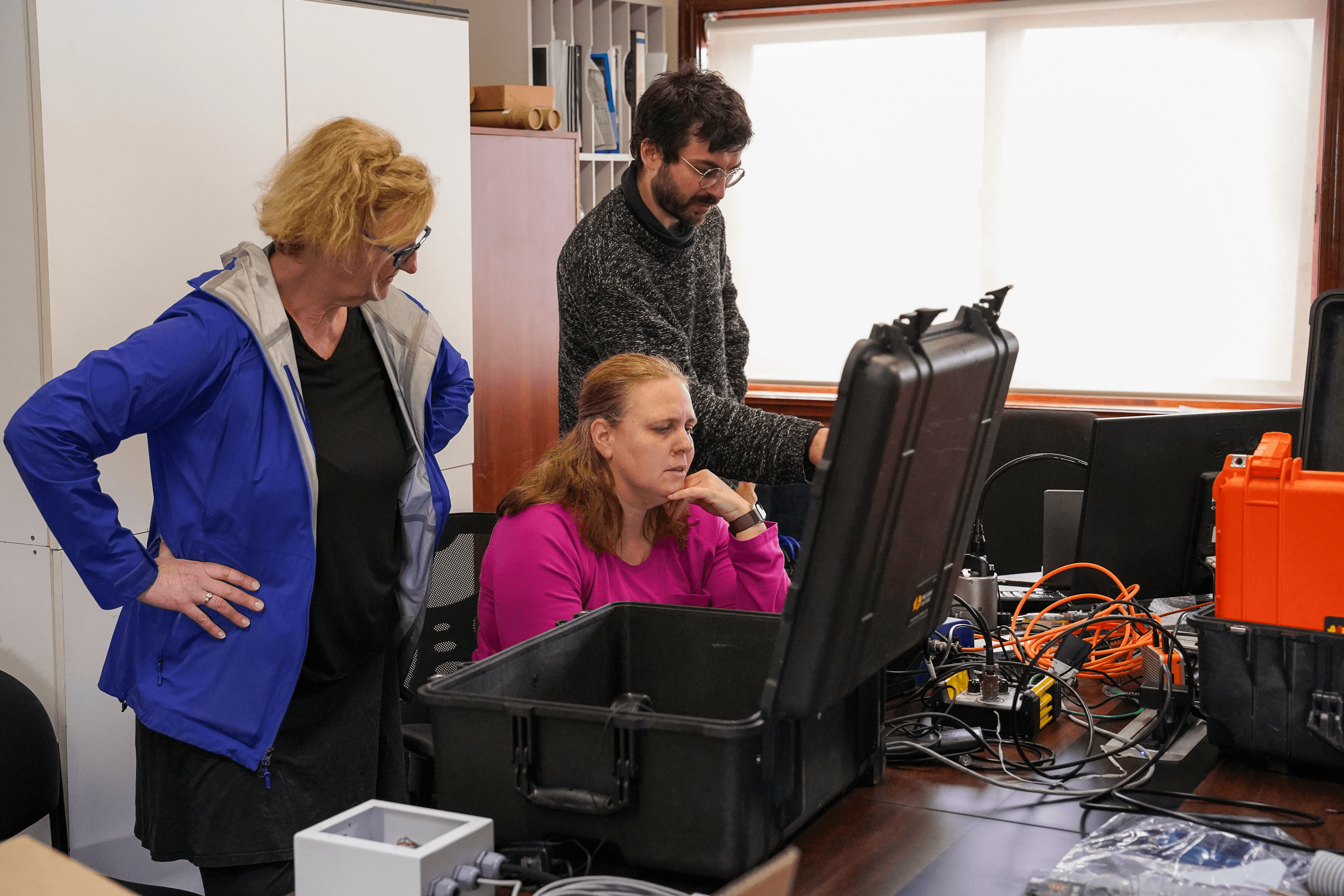
Image by Terry Plank
March 1 – March 7, 2026
During the first week of March, the AVERT team partners with Chilean scientists and engineers of OVDAS (Observatorio Volcanológico de los Andes del Sur), SERNAGEOMIN (Servicio Nacional de Geología y Minería) and the University of Chile, Santiago to deploy a suite of sensors on the crater rim of Chile’s highest threat volcano, Villarrica, or Ruka Pillañ in Mapudungun (RPV).
This is a challenging deployment as the crater rim is narrow, snow-covered for much of the year, and bathed in sulfurous fumes. It also hosts an intermittently active lava lake. Despite this inhospitable environment, RPV is a popular tourist destination for hikers and skiers. Thus, when the AVERT team first approached SERNAGEOMIN and OVDAS about a deployment in Chile, the crater rim of RPV was an obvious target for multi-parameter open data.
March 1 – 3
AVERT Team arrives in Temuco, OVDAS HQ:
Einat Lev, Terry Plank, Francesco Fiondella (LDEO/Columbia), with Conor Bacon (former AVERT postdoc, now of NORSAR) and Maarten de Moor (our collaborator in Costa Rica and MultiGas guru) with the OVDAS Team led by Begoña Fernanda Parraguez Landaeta (Director) and Carlos Melgarejo (lead Engineer). Alvaro Amigo (Head of the National Volcanic Monitoring Network, SERNAGEOMIN has provide critical support and leadership to the project)
Fortunately, our shipped equipment from LDEO (on Feb 6) arrived at OVDAS just before our arrival (Feb 27), so work commenced on wiring Pelican cases and sensors for power and communications.
The planned crater rim deployment includes:
Primary Site RKPI on the western side of the crater rim:
Broadband seismometer (Trillium Compact), GNSS (Resolute Polar), CO2 soil probe (Vaisala) and infrasound (Chaparral) with co-located visible and infrared cameras 20 m away pointing downward into the crater and intermittent lava lake. Six solar panels and 25 batteries will keep the site powered throughout the year, and the data will be telemetered by ratio to communication hub CVV.
The MultiGas Site RUKA will be sited on the eastern side of the crater rim, downwind of the crater vent gas plume. Two solar panels and 6 batteries will keep the site powered for as long the gas inlet remains clear of snow. SO2 , H2S, CO2 and H2O data, measured every second, will be telemetered to communication hub Llafenco.
RPV will be the only volcano in Chile with this collection of sensors, aimed at providing eyes (cameras), ears (infrasound), nose (MutiGas) and hands (seismometer and GNSS) on the ground.
March 3, 2026 is the 11 years anniversary of the last major eruption of RPV which produced a 1.5 km-high lava fountain, 6–8 km eruptive column, intense tephra fallout, agglutinate spatter flows, and > 20 km long lahar. There are some new shallow long period seismic and also acoustic events that appear to indicate renewed activity in the conduit and possible return of the lava lake. We are hoping any escalation of activity waits until after this week!
March 4 – 7
The group moves to Pucón to stage equipment at the ski area for helicopter sling loads to the
summit and site/sensor installations. As always, we pray to the weather gods, and to Ruka Pillañ!