CLEVELAND
ALASKA, USA
52.82211° N, 169.94488° W
OVERVIEW
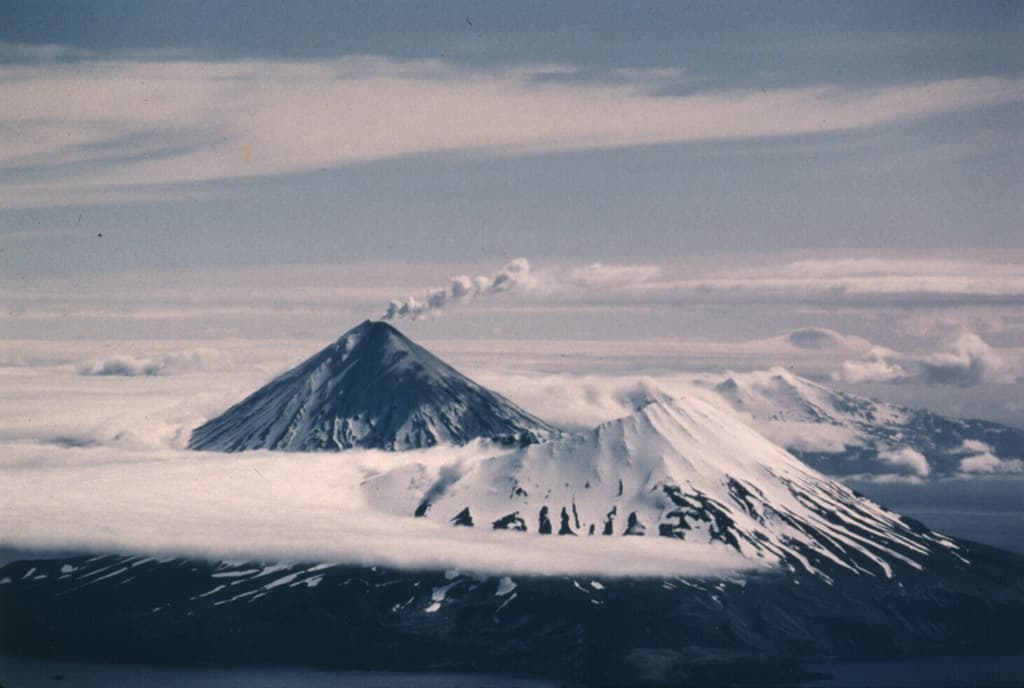
Cleveland volcano is one of the four peaks that comprise the Islands of Four Mountains
Mount Cleveland—among the most active volcanoes in the United States this century (Cameron et al., 2018)—is an andesitic stratovolcano on the western half of Chuginadak Island that, along with nearby Carlisle, Herbert, and Tana, comprises the Islands of Four Mountains group in the Aleutian arc. While it has been primarily classified as an "open-vent" system (per specification of Rose et al., 2013) due to persistent degassing from the summit crater, it has also exhibited repeated cycles of dome formation and destruction (de Angelis et al., 2021). Between 2005 and 2020, Cleveland saw frequent explosive eruptions, likely as a result of dome formation leading to a seal forming at the vent that in turn led to pressurisation of the system prior to an explosive event. Yet, due in large part to its remoteness and the associated difficulty of establishing a permanent network of instruments, few precursory signals have been recorded. In fact, prior to 2014, Cleveland volcano had no instruments despite having erupted every year since 2005. A significant amount of current knowledge on Cleveland's volcanic system has been derived from remote sensing techniques, such as gas flux (primarily SO2) estimates from space and the detection of explosions using distant infrasound sites (de Angelis et al., 2012).
NETWORK HISTORY
Cleveland's network before and after AVERT
Compare how monitoring sites, instruments, and telemetry links have changed across different phases of deployment


RECOMMENDED FOR YOU
Related reading
No articles found for cleveland.
SITES AND INSTRUMENTS
Cleveland Carlisle
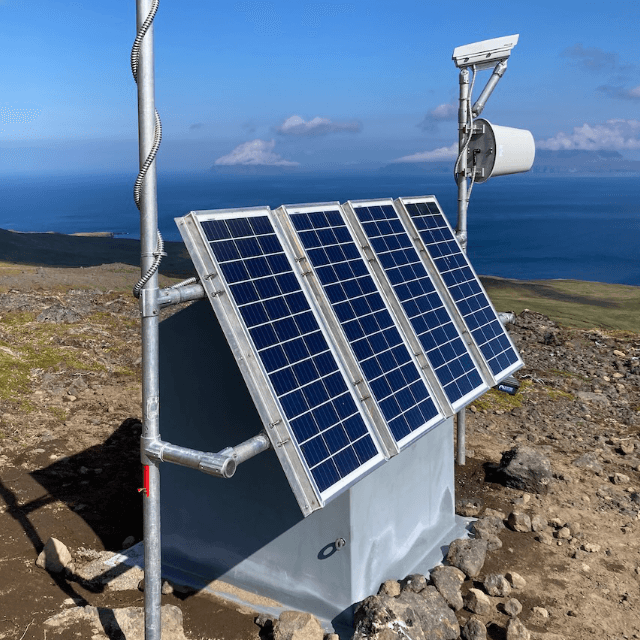
Seismic
This instrument is part of the network. Seismic data for this site are publicly available for download from the EarthScope Data Management Center (previously IRIS).
- Model: Trillium Compact 120PH
- Datalogger: Nanometrics Centaur